The sale goes from May 5th-6th, so you have a couple days to check out and wishlist the items you want to buy when the sale begins. Click the picture below to go straight to my store. Happy Shopping!
Showing posts with label teachers pay teachers. Show all posts
Friday, May 1, 2015
Teacher Appreciation Sale!
This was a "no brainer" for me to throw a sale alongside Teachers Pay Teachers. Feel free to browse through ALL of my products, as they are an ADDITIONAL 20% off. Check out my Products Page for many of my bundles. Great savings through TPT and my own personal sale.
The sale goes from May 5th-6th, so you have a couple days to check out and wishlist the items you want to buy when the sale begins. Click the picture below to go straight to my store. Happy Shopping!
Monday, April 27, 2015
Keeping Track of Data in the Classroom
As I have been out of the classroom now for over a year, I have had a lot of time to reflect on my strengths and weaknesses in the classroom. This post will be all about assessments and data in the classroom. First of all, I always blamed my lack of assessments and data tracking to time and lack of resources. I know now that as long as I am prepared ahead of time (aka, summer break), I can complete the assessments and track them appropriately throughout the school year.
I am still working on which assessments I want to use in my classroom this upcoming fall, and much of that will depend on what grade I teach. I just know, I am going make myself the goal of testing to make sure my students have a balanced literacy experience (comprehension, phonics, fluency, vocabulary, and phonological awareness). I plan on testing in these areas no matter what grade I teach, but they will be modified accordingly (i.e. I will not be testing 6th graders letter identification). You may be wondering why I would test phonics or phonological awareness even with 4th graders. I was working with a student over the last semester, and had an eye opening experience when the 4th grader I was working with was having issues with dipthongs, a few blends, and even some diagraphs. I was amazed that he did not know these skills, so I knew with a basic phonics assessments throughout the school year I can make sure my students know these basic foundational skills. My goal is to test in the beginning of the year, and depending on scores test some more frequently and others may not be tested again or just 3x a year. Hopefully I'll be able to update you all on what assessments I decide and how they work in my classroom!
A few things I do know is that I plan on testing fluency weekly and running records once a month. These are skills my former 2nd and 3rd graders struggled with and I did not test often enough. I used to test running records 3x a year, and moved students up to new levels without the data to back it up! YIKES! Now, I plan on testing 1-2 students a day and by the end of the month each student will have an updated score. This will help when they are self selecting books, deciding interventions, and guiding my differentiated instruction.
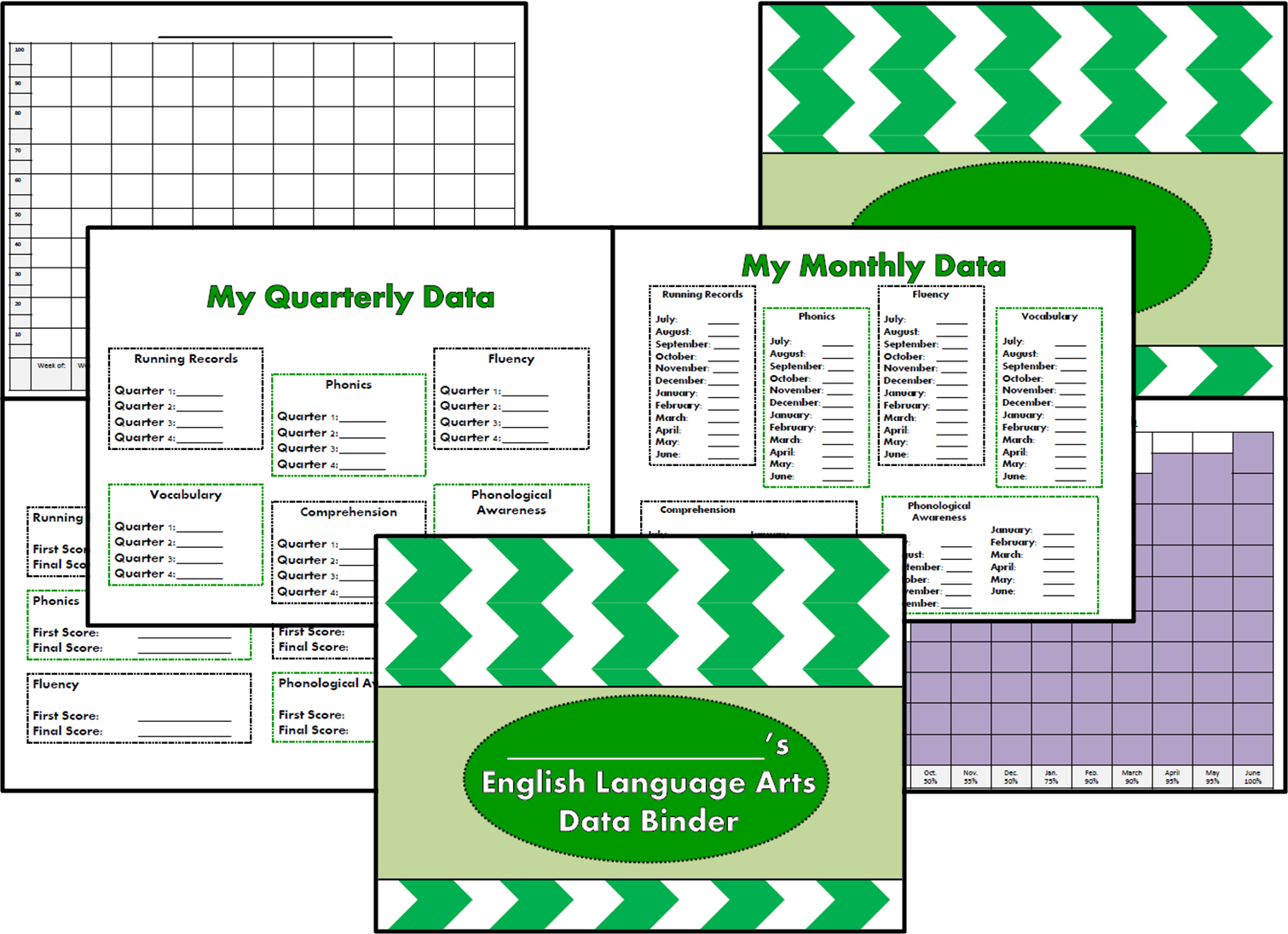
As I sat here, hoping to publish this post soon...I thought to myself "What would make this easier for me [and my readers] and what will help me actually accomplish this goal?" The answer was a recording sheet. Something I can keep at the front of my data binder or my lesson plan binder. So I stopped writing the post at the time, and went to create a recording sheet bundle for all of your ELA assessments. Now, because I know the struggle of keeping so on top of so many things...I am setting the price of this product as F-R-E-E! That way, you won't have any issues keeping track of who is left to give the fluency assessment or who is on my agenda for running records today?
Now, my next professional goal is individual interventions. I feel like this is still something I am not very good at deciding which intervention is best. So now that I have the data thing organized, my hopes is to do the RIGHT THING with this data. What is the point of having the data if you don't do anything with it, right? My first step is to look more into websites like:
Feel free to comment with other intervention websites that are free for myself and other readers to try. My hopes are that using some of these great online resources, I can get a good start on finding the right interventions for struggling students. Maybe one day, I'll be posting my own interventions on my TPT Store. Until then...
I love getting students involved in assessments and making goals. It makes it less scary and more motivating for all!
Another motivator and piece of ownership is data binders for math facts. Students had to get a 95% or higher at the time (this was my first time trying data folders). This upcoming year, I will ask students to get a 100% to move on. I'm so mean, right? haha!
I am still working on which assessments I want to use in my classroom this upcoming fall, and much of that will depend on what grade I teach. I just know, I am going make myself the goal of testing to make sure my students have a balanced literacy experience (comprehension, phonics, fluency, vocabulary, and phonological awareness). I plan on testing in these areas no matter what grade I teach, but they will be modified accordingly (i.e. I will not be testing 6th graders letter identification). You may be wondering why I would test phonics or phonological awareness even with 4th graders. I was working with a student over the last semester, and had an eye opening experience when the 4th grader I was working with was having issues with dipthongs, a few blends, and even some diagraphs. I was amazed that he did not know these skills, so I knew with a basic phonics assessments throughout the school year I can make sure my students know these basic foundational skills. My goal is to test in the beginning of the year, and depending on scores test some more frequently and others may not be tested again or just 3x a year. Hopefully I'll be able to update you all on what assessments I decide and how they work in my classroom!
A few things I do know is that I plan on testing fluency weekly and running records once a month. These are skills my former 2nd and 3rd graders struggled with and I did not test often enough. I used to test running records 3x a year, and moved students up to new levels without the data to back it up! YIKES! Now, I plan on testing 1-2 students a day and by the end of the month each student will have an updated score. This will help when they are self selecting books, deciding interventions, and guiding my differentiated instruction.
As I sat here, hoping to publish this post soon...I thought to myself "What would make this easier for me [and my readers] and what will help me actually accomplish this goal?" The answer was a recording sheet. Something I can keep at the front of my data binder or my lesson plan binder. So I stopped writing the post at the time, and went to create a recording sheet bundle for all of your ELA assessments. Now, because I know the struggle of keeping so on top of so many things...I am setting the price of this product as F-R-E-E! That way, you won't have any issues keeping track of who is left to give the fluency assessment or who is on my agenda for running records today?
Data Recording Sheets {FREEBIE}
Now, my next professional goal is individual interventions. I feel like this is still something I am not very good at deciding which intervention is best. So now that I have the data thing organized, my hopes is to do the RIGHT THING with this data. What is the point of having the data if you don't do anything with it, right? My first step is to look more into websites like:
Feel free to comment with other intervention websites that are free for myself and other readers to try. My hopes are that using some of these great online resources, I can get a good start on finding the right interventions for struggling students. Maybe one day, I'll be posting my own interventions on my TPT Store. Until then...
Wednesday, April 22, 2015
101 Reasons to Discuss Careers in the Classroom
Recently I have been thinking about my students and their futures. A few years ago, I taught summer school and each classroom focused on a college around the country to be the theme for the 6 week session. Many of us contacted the universities and they sent us promotional products to hang up in the classroom and pass out among the students. Big props to Ball State University for sending me TONS of pencils, posters, cups, calendars, etc. for my students. These little kindergarteners were THRILLED with all the goodies. Plus, it got them thinking at such an early age about college and their future. Now, I highly recommend something similar in your classroom. Whether you focus every week on a new college or something like that, it just gets your students [of all backgrounds] thinking about their future. Now, since I taught summer school I have not done this in my classroom, but it is always in the back of my mind.
I took it a step past colleges and focused on careers. I created a product with 101 careers. The product allows me to use cooperative learning strategies at tables, or focus on 1-2 careers a week. I made sure to have a variety of careers, so it would open students eyes past "doctor" and take it a step further "Pediatrician" or "teacher to college professor". When I used cooperative learning strategies in the classroom, I would give each table 2 careers to research. Now, I was at an advantage here, as my students have individual tablets. You could easily assign the tables or groups careers and then head to the computer lab for them to do the exact same thing. From that, there are pages in their product for student responses. They write notes on the job requirements and job responsibilities. Students, then join their group to share and discuss results found. Then, tables share out about their job, and we come up with 10-12 careers to share with the entire class.
After completing 25 careers, students can fill out a "Checkpoint" sheet. This allows students to answer some questions about the careers they have learned about. My premade order gives a variety of careers, so hopefully, every student can find some sort of interest. But you're more than welcome to do them in any order as there are two sets: one with numbers and one without. In the checkpoints, it allows students to research a college they could attend to do this career. My hopes is to get them thinking about colleges, and having them understand to do that job they have to work hard to make it through elementary, middle, high school, and college to do the career of their dreams! Maybe word that differently to them, as it sounds pretty daunting. ha!
If cooperative learning is not your thing, you can easily cover a few of these a week through teacher modeling and instruction. Together, you could make a K-W-L chart on a career, and do the research together as a class to fill in the rest of the graphic organizer. This, personally, does not work with my teaching style as my students are very hands on in the classroom. I try to "stay out of the way" after modeling and guided practice.
Another option I might try in my classroom to save some time is to add it to my morning work routine. Students will be given a notebook (to save printer paper!) to research the Career of the Day on the blackboard. They write information found via tablets (or preprinted resources) about the career. This would be something I would include as a secondary element to my morning work routine, as I want them to have some grammar and math practice as well. But this is a GREAT authentic way for students to be reading, writing, and researching first thing in the morning. Students would take notes, and at the beginning of writing time we would discuss the career for 7-10 minutes and fill out the main sheet together. I plan on keeping these in a binder for student reference throughout the year. I am really excited to try this with my students this upcoming year.
A fun way to have some closure to the assignment (if you just do 75 or all 101) is to have a Career Day. In the past (before creating this document), we had a career day for our second graders. They researched a career of choice, and then wrote a paper describing why they wanted to be that job (3 paragraphs). Students could pick their career of choice, and write a great research paper about the career. Paragraphs could include:
Overall, this product gives you a variety of options...but most importantly it helps your students think of the future. If they have a BIG goal in mind, you'll be able to get them to work hard in your classroom to achieve that goal. To add one more spin on the product, have community members come in to speak about their careers periodically. Maybe after you reach 25 careers, have 5 professionals from that chunk of careers come into speak. It will impress the visitors that your students know (or hopefully know) what the the career does and ask thoughtful questions to the professionals.
Good luck! Feel free to tell me how you used this product in your own classroom! I love hearing how my products are used in other classrooms.
I took it a step past colleges and focused on careers. I created a product with 101 careers. The product allows me to use cooperative learning strategies at tables, or focus on 1-2 careers a week. I made sure to have a variety of careers, so it would open students eyes past "doctor" and take it a step further "Pediatrician" or "teacher to college professor". When I used cooperative learning strategies in the classroom, I would give each table 2 careers to research. Now, I was at an advantage here, as my students have individual tablets. You could easily assign the tables or groups careers and then head to the computer lab for them to do the exact same thing. From that, there are pages in their product for student responses. They write notes on the job requirements and job responsibilities. Students, then join their group to share and discuss results found. Then, tables share out about their job, and we come up with 10-12 careers to share with the entire class.
After completing 25 careers, students can fill out a "Checkpoint" sheet. This allows students to answer some questions about the careers they have learned about. My premade order gives a variety of careers, so hopefully, every student can find some sort of interest. But you're more than welcome to do them in any order as there are two sets: one with numbers and one without. In the checkpoints, it allows students to research a college they could attend to do this career. My hopes is to get them thinking about colleges, and having them understand to do that job they have to work hard to make it through elementary, middle, high school, and college to do the career of their dreams! Maybe word that differently to them, as it sounds pretty daunting. ha!
If cooperative learning is not your thing, you can easily cover a few of these a week through teacher modeling and instruction. Together, you could make a K-W-L chart on a career, and do the research together as a class to fill in the rest of the graphic organizer. This, personally, does not work with my teaching style as my students are very hands on in the classroom. I try to "stay out of the way" after modeling and guided practice.
Another option I might try in my classroom to save some time is to add it to my morning work routine. Students will be given a notebook (to save printer paper!) to research the Career of the Day on the blackboard. They write information found via tablets (or preprinted resources) about the career. This would be something I would include as a secondary element to my morning work routine, as I want them to have some grammar and math practice as well. But this is a GREAT authentic way for students to be reading, writing, and researching first thing in the morning. Students would take notes, and at the beginning of writing time we would discuss the career for 7-10 minutes and fill out the main sheet together. I plan on keeping these in a binder for student reference throughout the year. I am really excited to try this with my students this upcoming year.
Get the product HERE!
A fun way to have some closure to the assignment (if you just do 75 or all 101) is to have a Career Day. In the past (before creating this document), we had a career day for our second graders. They researched a career of choice, and then wrote a paper describing why they wanted to be that job (3 paragraphs). Students could pick their career of choice, and write a great research paper about the career. Paragraphs could include:
- Opening Paragraph
- Job Requirements
- Job Responsibilities
- College Requirements (what college, classes, etc.)
- Why is it the best fit for the student?
- Closing Paragraph
Overall, this product gives you a variety of options...but most importantly it helps your students think of the future. If they have a BIG goal in mind, you'll be able to get them to work hard in your classroom to achieve that goal. To add one more spin on the product, have community members come in to speak about their careers periodically. Maybe after you reach 25 careers, have 5 professionals from that chunk of careers come into speak. It will impress the visitors that your students know (or hopefully know) what the the career does and ask thoughtful questions to the professionals.
Good luck! Feel free to tell me how you used this product in your own classroom! I love hearing how my products are used in other classrooms.
Labels:
101,
career day,
careers,
college,
colleges,
editing,
future,
goals,
jobs,
modeling,
professionals,
projects,
research,
resources,
revising,
teachers pay teachers,
technology,
TPT,
writing,
writing process
Friday, March 27, 2015
Help Me Celebrate my Store's Milestone!
This past week has been great for 3L + 1T...I reached a personal milestone that I have been working on for quite some time. To thank all of my loyal customers, I am throwing a 10% Off Sale for all of my products. The sale goes from March 28th-30th. Please help me celebrate by picking up some of your wishlist
As for more products, I am so sorry I haven't been able to update the blog in almost 2 months! Yikes. I have many great new products that will get to prepared for the end of the school year...and I hate to say it---next school year as well! Hard to believe we're almost ready for another school year. But for now, enjoy all 110 of my products at a discount.
Again, THANK YOU for all of your purchases, support, and ideas! 3L + 1T would not be here without you! This milestone is the first of many because when I get 100 more sales I will be throwing ANOTHER sale! Help me reach this second milestone by shopping now with this great discount.
As for more products, I am so sorry I haven't been able to update the blog in almost 2 months! Yikes. I have many great new products that will get to prepared for the end of the school year...and I hate to say it---next school year as well! Hard to believe we're almost ready for another school year. But for now, enjoy all 110 of my products at a discount.
Again, THANK YOU for all of your purchases, support, and ideas! 3L + 1T would not be here without you! This milestone is the first of many because when I get 100 more sales I will be throwing ANOTHER sale! Help me reach this second milestone by shopping now with this great discount.
Sunday, February 1, 2015
Celebrating Valetine's Day Early at 3L + 1T
It is February 1st so...Valentine's Day is RIGHT around the corner. Have you started to think about what you want to do in your own classroom? I'm sure there will be yummy treats, cute little crafts, and maybe some cards exchanged. Have you thought of some fun ways to include learning into the mix of it all?
Have no fear, Mrs. Valentine's Day to the rescue! Catchy, right? I have created a few products that will allow your students to still have fun, think about the holiday, and learn as well!
The Perfect Match: Synonyms & Antonyms
I cannot wait to use this in my classroom! I think this activity will be great when working in small groups during stations/centers. The product includes:
The assessments would also be great to use after a mini-lesson or when you feel your students are close to mastery. The assessments include matching, defining, using in a sentence, and identifying. The final assessment asks students to write a story of their choice. They must use a certain amount of synonyms and anytonmys. When finished, they must go back to underline and circle those words they used. I love assessments that allow students to be creative, but also apply the skills they learned.
Have no fear...this product isn't JUST for Valentine's Day. Use this all year around, as the only thing Valentine's Day about this is the hearts and the title.
Valentine's Day Letter Writing
I just reduced this price on this product! I created 2 templates---one a post-card and the other a letter for students to write friendly letters to teachers, friends, and/or family members. This would be a great way to start your day off. Have students finish up before starting your day of lessons and during the celebration in the afternoon...take a 10-20 minute break to go and hand deliver the letters/post-cards. It will make someone's day! I love teaching students about the gift of giving. Check out my Christmas post here to see how I try to do this all year long!
I would absolutely love to see these products in action, especially the post-cards and letter templates. Feel free to comment below to share some of your student's work!
Valentine's Day Synonym Cloze Writing
The last item for you to pick (also reduced in price) from is a Valentine's Day synonym cloze activity. This one is great for a writing center, morning work, or an "early finisher" type activity. Students are asked to read the letter and fill in words that would make sense or use the word bank in the bottom part of the paper to help students. The choice is up to you! Although there is a answer key included...but you can always ignore that! Make it even more challenging for your students and have them create their own letter using 10 "fancy" adjectives. Have them impress their loved ones.
Have no fear, Mrs. Valentine's Day to the rescue! Catchy, right? I have created a few products that will allow your students to still have fun, think about the holiday, and learn as well!
The Perfect Match: Synonyms & Antonyms
I cannot wait to use this in my classroom! I think this activity will be great when working in small groups during stations/centers. The product includes:
- 21 pairs of matching synonym cards
- 21 pairs of matching antonym cards
- 1 quick check assessment for synonyms
- 1 quick check assessment for antonyms
- 1 combined assessment to use a synonyms and antonyms in writing a story and identify the words they used
The assessments would also be great to use after a mini-lesson or when you feel your students are close to mastery. The assessments include matching, defining, using in a sentence, and identifying. The final assessment asks students to write a story of their choice. They must use a certain amount of synonyms and anytonmys. When finished, they must go back to underline and circle those words they used. I love assessments that allow students to be creative, but also apply the skills they learned.
Have no fear...this product isn't JUST for Valentine's Day. Use this all year around, as the only thing Valentine's Day about this is the hearts and the title.
Check it out...here!
Valentine's Day Letter Writing
I just reduced this price on this product! I created 2 templates---one a post-card and the other a letter for students to write friendly letters to teachers, friends, and/or family members. This would be a great way to start your day off. Have students finish up before starting your day of lessons and during the celebration in the afternoon...take a 10-20 minute break to go and hand deliver the letters/post-cards. It will make someone's day! I love teaching students about the gift of giving. Check out my Christmas post here to see how I try to do this all year long!
I would absolutely love to see these products in action, especially the post-cards and letter templates. Feel free to comment below to share some of your student's work!
Grab the product...here!
Valentine's Day Synonym Cloze Writing
The last item for you to pick (also reduced in price) from is a Valentine's Day synonym cloze activity. This one is great for a writing center, morning work, or an "early finisher" type activity. Students are asked to read the letter and fill in words that would make sense or use the word bank in the bottom part of the paper to help students. The choice is up to you! Although there is a answer key included...but you can always ignore that! Make it even more challenging for your students and have them create their own letter using 10 "fancy" adjectives. Have them impress their loved ones.
Get the product here
Start a Valentine's Day theme next week with your students right before the holiday. I am really excited to complete this project with my class. The project goes through each of the stages of the writing process. Students can start with a heart shaped graphic organizer so they can organize their thoughts. I focused a lot on the next stage which is explaining each one of those hearts in greater detail. This is where I see my students struggle as they do not know what to say about these subtopics. From there, there a page dedicated to each heart where students can organize their thoughts deeper so they can elaborate on the individual hearts.
The next steps are to write the first draft, edit, and revise. Students are given the appropriate paper, and a small quick-check rubric so they can remember to check their own work. I normally incorporate another rubric into the mix---one that I make with students before starting the writing so they understand their expectations and objectives from the start.
Students can finish the project by rewriting their paper on the final draft format and complete a picture in the decorative hearts as a final step in their publishing. I also like this project because you can make it into packet format to complete together, in small group, or individually if you think your students are up for the challenge.
Hope you enjoy this and more importantly...your students have fun with this!
Happy {Early} Valentine's Day! Don't forget to share the love by pinning, liking, and sharing my products on your social media sites!
Labels:
adjectives,
antonyms,
assessments,
christmas,
cloze,
elementary,
fancy words,
holiday,
letters,
matching,
post cards,
sharing,
synonyms,
teachers pay teachers,
template,
tests,
TPT,
valentine's day,
word work,
writing
Friday, December 12, 2014
Help! What do I do with Students who Finish Early with....EVERYTHING?
What to do with students who finish early on EVERY task? Well, we all know the best thing you should be doing is differentiated for that student. You should be giving them the appropriate level of work. But, as teachers, we know we need them to prove themselves with their current grade level material before we move onto more challenging work. So what do you do in this battle?
We all know everyone has their own strengths and weaknesses. One of my weaknesses is keeping up with my blog posts like I would like to!!
When I am unable to predict a student is going to finish a task early; I have a back up plan! I have created these folders to hang on my wall, but if you don't have the space, you can easily put them in a binder or on a shelf.
I created mini-topic sheets that go along with the Common Core Standards (Both Math & English Language Arts). It works for grades 1-5. Each topic sheet is correlated with a standard subject such as, Figurative Language or Subtraction. I normally keep them general, so many different activities can go into those folders. I do not put out all the subject areas at one time because that tends to be overwhelming or we may have not covered that particular subject yet. I put out four ELA and four Math folders, and the subjects include ones I am covering that quarter (but this could easily be done monthly or even weekly if you prefer). Visit my TPT Store for activities and worksheet ideas!
I put the covers in a clear plastic binder sheet, and attach it to a regular pocket-folder. Inside each pocket-folder is a variety of activities, worksheets, resources, etc. that a student could do if he/she finishes early. I train students early in the year when you can/can't go get "extra work". This eliminates students getting up saying they are "done" with independent reading. HA!
Now I know what you're thinking...worksheets?! Really? I select these worksheets to be a challenge or great extra practice for students with that particular skill. I am not just throwing out random worksheets as "time killers". I want students to get better. I mean, that's my job, right? I look through the internet or my file cabinet to find appropriate activities/worksheets and make a handful of copies. I learned early on to not copy 20+, because it will just be a waste of paper.
Along with the early finishers, I allow students to pick a few worksheets to take home for "extra homework". Before you think I'm crazy, I give students a reward if they do it to the best of their ability and bring it back so I can look it over. In our school, we use a tally system which leads to bigger prizes, etc. I gave them a tally for each paper they brought back. If you don't have something like this in your school, you can easily handout coupons to reward them for going Above & Beyond! You could keep track of how many "extra" sheets they do, and they get a reward ever 4-5 times they turn something in (depending on the grade you teach). It may seem little, but these extra minutes of practice are going to help them become successful students, pass those high-stakes exams, and be proud of the fact that they are working harder than they need to!
We all know everyone has their own strengths and weaknesses. One of my weaknesses is keeping up with my blog posts like I would like to!!
When I am unable to predict a student is going to finish a task early; I have a back up plan! I have created these folders to hang on my wall, but if you don't have the space, you can easily put them in a binder or on a shelf.
I created mini-topic sheets that go along with the Common Core Standards (Both Math & English Language Arts). It works for grades 1-5. Each topic sheet is correlated with a standard subject such as, Figurative Language or Subtraction. I normally keep them general, so many different activities can go into those folders. I do not put out all the subject areas at one time because that tends to be overwhelming or we may have not covered that particular subject yet. I put out four ELA and four Math folders, and the subjects include ones I am covering that quarter (but this could easily be done monthly or even weekly if you prefer). Visit my TPT Store for activities and worksheet ideas!
Glue them on the folder or a clear sleeve. Put them in a bin or hang them...the choice is up to you!
I put the covers in a clear plastic binder sheet, and attach it to a regular pocket-folder. Inside each pocket-folder is a variety of activities, worksheets, resources, etc. that a student could do if he/she finishes early. I train students early in the year when you can/can't go get "extra work". This eliminates students getting up saying they are "done" with independent reading. HA!
Now I know what you're thinking...worksheets?! Really? I select these worksheets to be a challenge or great extra practice for students with that particular skill. I am not just throwing out random worksheets as "time killers". I want students to get better. I mean, that's my job, right? I look through the internet or my file cabinet to find appropriate activities/worksheets and make a handful of copies. I learned early on to not copy 20+, because it will just be a waste of paper.
Along with the early finishers, I allow students to pick a few worksheets to take home for "extra homework". Before you think I'm crazy, I give students a reward if they do it to the best of their ability and bring it back so I can look it over. In our school, we use a tally system which leads to bigger prizes, etc. I gave them a tally for each paper they brought back. If you don't have something like this in your school, you can easily handout coupons to reward them for going Above & Beyond! You could keep track of how many "extra" sheets they do, and they get a reward ever 4-5 times they turn something in (depending on the grade you teach). It may seem little, but these extra minutes of practice are going to help them become successful students, pass those high-stakes exams, and be proud of the fact that they are working harder than they need to!
Thursday, November 27, 2014
My Gift to YOU!
Happy Holidays from 3L + 1T! My gift to you all for being great followers, a Teachers Pay Teachers sale! On December 1st and 2nd, enjoy 20% off of ALL (yes, that is correct) ALL of my products in my store. With the gift TPT is giving you, you can save up to 28% on products. What a great way to start the New Year!
Click the banner above to go directly to my store!
Check out my other blog posts for great ideas and direct links to products.
Classroom Rewards
Writing as Homework
Student Data Tracking: Reading Levels
Review Cards: ELA
Spring Activities
Multiplication Bulletin Board
Writing as Homework
Student Data Tracking: Reading Levels
Review Cards: ELA
Spring Activities
Multiplication Bulletin Board
Labels:
20%,
blog,
centers,
ELA,
genres,
holiday,
holidays,
organization,
posts,
sale,
school,
stations,
summer,
teachers pay teachers,
thanksgiving,
TPT
Wednesday, November 26, 2014
Adding Literacy During the Holidays
Book Clubs
Winter Break is right around the corner which means students will start getting a little antsy as they are getting ready to be on an extended beak and well for the most of us around the States they are stuck inside because of cold and snowy weather outside. I really try to make the 3 weeks in December really engaging, although I want them to still have lots of academics before break as well. Chances are many students won't read a single word over their 2-week break. Scary, Scary, Scary!
I LOVE book clubs, or many call them, literature circles. I enjoy these because they are highly engaging, group oriented, bring a lot of discussion amount equivalent readers, and all have the reading/writing connection. I have created 4 different holiday book clubs for my third grade classroom. The book selection was based on the needs of my classroom, so these may not translate to every third grade class around the world.
Each group met with the teacher 2-3 times during their 7-day book club project. I know 7 days does not match up with a normal school week, so it was technically a two week project (10 days). Seven days they were reading, 1-2 days to catch up if we were behind, and/or 1-2 days to complete the final project.
The final projects were group oriented and we spent 1.5 Literacy Blocks completed them. Because I wanted everyone to learn about the books other groups read, we created large movie posters (No pictures...bummer, I know!) to try to entice classmates to read this book over break. Each student had a job (writer, artist, leader, supply manager, time manager, question master, presenter). I hope to have a blog post soon on how these group activities work in my classroom.
After they completed their movie poster, they presented to the class what the book was about (without giving too much away). It was a great informal assessment as you could truly tell which group members understood the book well and could answer the questions their classmates asked with confidence. I added this as a grade as well.
A little more about the books/questions:
Adjective Passage
If you are not looking to create a huge project around the holidays, as there is too many assessments, projects, papers, etc. due I also love included reading into grammar skills. No matter the grammar subject, my students are always reading and identifying it in text. I think students retain the information more when they practice in text rather than the skill in isolation.
I have created a passage that has LOADS of adjectives in it. Students are asked to read the passage and find the adjectives within it. Where does the holiday part come in you may ask? Well, the passage is about a snow day! Many of us can already relate to a snowy filled day already this year!
Students will circle all the adjective they find in the text, but then they are also asked to draw a line to the noun it is describing, as that is just as important as the adjective itself.
Winter Break is right around the corner which means students will start getting a little antsy as they are getting ready to be on an extended beak and well for the most of us around the States they are stuck inside because of cold and snowy weather outside. I really try to make the 3 weeks in December really engaging, although I want them to still have lots of academics before break as well. Chances are many students won't read a single word over their 2-week break. Scary, Scary, Scary!
I LOVE book clubs, or many call them, literature circles. I enjoy these because they are highly engaging, group oriented, bring a lot of discussion amount equivalent readers, and all have the reading/writing connection. I have created 4 different holiday book clubs for my third grade classroom. The book selection was based on the needs of my classroom, so these may not translate to every third grade class around the world.
- Judy B. Jones and the Yucky Blucky Fruitcake (GR: Level M)
- Judy Moody & Stink, The Holly Joliday (GR: ~Level M)
- Miss Holly is Too Jolly (GR: Level O)
- Who is Stealing the 12 Days of Christmas? (GR: Level Q)
Each group met with the teacher 2-3 times during their 7-day book club project. I know 7 days does not match up with a normal school week, so it was technically a two week project (10 days). Seven days they were reading, 1-2 days to catch up if we were behind, and/or 1-2 days to complete the final project.
The final projects were group oriented and we spent 1.5 Literacy Blocks completed them. Because I wanted everyone to learn about the books other groups read, we created large movie posters (No pictures...bummer, I know!) to try to entice classmates to read this book over break. Each student had a job (writer, artist, leader, supply manager, time manager, question master, presenter). I hope to have a blog post soon on how these group activities work in my classroom.
After they completed their movie poster, they presented to the class what the book was about (without giving too much away). It was a great informal assessment as you could truly tell which group members understood the book well and could answer the questions their classmates asked with confidence. I added this as a grade as well.
A little more about the books/questions:
Judy B. Jones group is asked to complete summaries of each chapter they complete using Somebody, Wanted, But, So, Then and then completed a final summary in paragraph form of the book. Judy Moody's group is asked to complete a variety of questions about the text. They are comparing/contrasting, describing, identifying, and summarizing.
Miss. Holly is Too Jolly asks group members to complete a variety of questions including grammar based, comparing, identifying, giving details, and summarizing. Who is Stealing the 12 Days of Christmas? is all summaries of the chapter(s) read in paragraph form.
*Each group has the "Rate this Book" at the end of
Adjective Passage
If you are not looking to create a huge project around the holidays, as there is too many assessments, projects, papers, etc. due I also love included reading into grammar skills. No matter the grammar subject, my students are always reading and identifying it in text. I think students retain the information more when they practice in text rather than the skill in isolation.
I have created a passage that has LOADS of adjectives in it. Students are asked to read the passage and find the adjectives within it. Where does the holiday part come in you may ask? Well, the passage is about a snow day! Many of us can already relate to a snowy filled day already this year!
Students will circle all the adjective they find in the text, but then they are also asked to draw a line to the noun it is describing, as that is just as important as the adjective itself.
Get this product...here!
Tuesday, November 11, 2014
Gobble! Gobble! Gobble!
Thanksgiving is a fun time for students as they are learning important parts of our nation's history (for those reading this blog from the States). But it is also a time to have a little fun by incorporating some of the great foods, traditions, and crafts into our lessons...when we all have time! I have some sneaky ways to include fun into your classroom, while students are still learning and highly engaged!
Thanksgiving Graphing:
I try to make my graphing unit (2nd grade) around the time Thanksgiving rolls around. This is a great time period to have student survey family, friends, etc. and graph their results. In the past, with my 2nd grade team, we would have students survey family/friends about their favorite type of pie and show results on a Bar Graph. You can also have fun with Pie Graphs given the name of the game!
I have created a simple document for you to model how to create data from surveying all the way to the analysis part. I have a teacher example for all three stages. The students have a "Take Home" document that tells them the steps to take and send the student copies home. Students are to complete a survey to at least 10 family/friends that they know, asking them their favorite Thanksgiving pie flavor. You can obviously pick your own prompt, but the questioning will not go with it. I have provided 25 survey ideas for you to use, to assign students, or to give students some ideas to survey friends/family members about.
Graphing: Quick Assessment/Activity
After finishing the "Take-Home" assignment, you can test student's knowledge by having them complete a pre-made survey to create the bar graph and analysis portion. I have used this as a quick assessment to check my students' understanding of basic graphic. Although, this activity does not make them do the surveying due to time. It is also a fun activity to have students do the day before Thanksgiving as an educated math lesson, but still involves crayons and food!
Graphing
Thanksgiving Graphing:
I try to make my graphing unit (2nd grade) around the time Thanksgiving rolls around. This is a great time period to have student survey family, friends, etc. and graph their results. In the past, with my 2nd grade team, we would have students survey family/friends about their favorite type of pie and show results on a Bar Graph. You can also have fun with Pie Graphs given the name of the game!
I have created a simple document for you to model how to create data from surveying all the way to the analysis part. I have a teacher example for all three stages. The students have a "Take Home" document that tells them the steps to take and send the student copies home. Students are to complete a survey to at least 10 family/friends that they know, asking them their favorite Thanksgiving pie flavor. You can obviously pick your own prompt, but the questioning will not go with it. I have provided 25 survey ideas for you to use, to assign students, or to give students some ideas to survey friends/family members about.
Get your own copy...HERE!
Graphing: Quick Assessment/Activity
After finishing the "Take-Home" assignment, you can test student's knowledge by having them complete a pre-made survey to create the bar graph and analysis portion. I have used this as a quick assessment to check my students' understanding of basic graphic. Although, this activity does not make them do the surveying due to time. It is also a fun activity to have students do the day before Thanksgiving as an educated math lesson, but still involves crayons and food!
Click HERE to get your own copy
Another cookie version is available HERE
Numbers
Roll a Thanksgiving Dinner:
I love the "Roll a..." activity, and I have a few in my TPT store for you to get during all of the holidays throughout the school year. If you haven't heard of this type of activity, here is the breakdown:
- Students usually work in partners or small groups.
- They take turns rolling dice.
- Once they roll the dice, they read the number. The number correlates with an item to draw to create their holiday picture. For example, if they roll a 1, they must draw the plate. The fun comes in when they are looking for a specific number to roll to complete their picture and they can't get it.
- Students should finish with, in this case, a Thanksgiving dinner drawn on the paper you provide them.
Here's the product...you know you want it!
For more "Roll a..." activities:
Saturday, July 26, 2014
31 Reasons to Visit my Teachers Pay Teachers Store
I love the feeling of a sale! I guess you could say I have a shopping problem, but when I walk through the mall or get sale coupons in my email...I just get excited! My Back-to-School gift for my 3L + 1T followers is a sale on 31 of my Back-to-School products starting tomorrow, July 27th.
I have went through all of my products to select the Top 31 items that will make the beginning of the year go smoothly for you all. Take advantage of this sale it won't last forever! Hint: Sale ends July 29th!
Check out the products below:
I have went through all of my products to select the Top 31 items that will make the beginning of the year go smoothly for you all. Take advantage of this sale it won't last forever! Hint: Sale ends July 29th!
Click HERE if you're ready to go SHOPPING!
Check out the products below:
To find these items, visit my store. Then you can search for the title of the product you'd like to purchase.
I thank you in advance for your purchases. Please leave feedback once you have made the purchase. I wish you a smooth start to your school year and a fantastic year! Go Teachers!
Thursday, July 17, 2014
First Day of School Activities
There are thousands of different things you can do on the first day, so I'm not saying mine is the perfect combination...it just works for me! I like to start the first day discussing and teaching them about teamwork. All of our [fun] activities are about teamwork throughout the day. Let me clarify, this post is just about the activities you can do during the day, not the strategic, organizing, & procedures that need to be taught. Check out An Organized First Day of School for more information in the preparing for this first day!
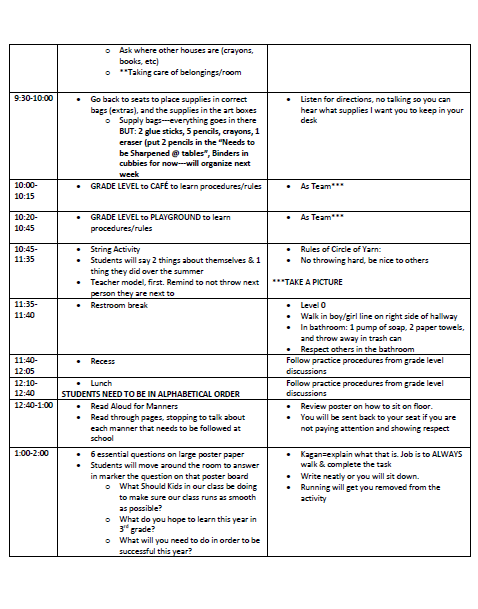
One suggestion I have to help first year teachers who are feeling a bit overwhelmed about planning for the first day is to keep with your normal time schedule. What I mean by this is if you have scheduled an hour for your math block, do some sort of other activity (get to know you, supplies, organization, etc). for that hour. This will get you set into the timing of your day when you get normal subject areas in the mix. It will also train students with the natural transitions subconsciously. Now, I'm not crazy, I know things will come up unexpectedly during the first day...but sticking to this the best you can will help all. I had to break a few of my blocks down because of School-wide or grade level procedure times. Check out my "normal" schedule compared to my first day of school schedule.
Daily Schedule:
So let's let the fun begin with the ACTIVITIES!
Introduction Activity
While students are coming in from their morning transportation, having instructions on the board (depending on the age, obviously) that they can follow, as well as a "Get to Know You" activity. I just have a general questionnaire about their likes/dislikes/goals, etc. This will keep them focused and something that is not too challenging, as you don't know the level many of these students are coming in with. I already have this form on their desk with a sharpened pencil, so there is no confusion on the task.
String Activity
I have students move the desks back, so we can form one large circle as a class. I then explain that they will be throwing a ball of string around. I show a few times the right and wrong ways to throw the ball of string. I normally get a few giggles on the bad way to throw, which proves my point on not throwing it hard or crazy. Students behave (first day jitters, perhaps?) and throw the ball of string like I ask them to.
After modeling the throw, I start all over and tell them when they catch the ball they will tell the class: 1 thing about themselves, 1 thing they did over the summer, & 1 thing they are looking forward to this school year. You don't have to do these exactly, but I felt I got a brief overview of the class with their likes and goals for the school year. After the student shares they have to say a person's name across the circle (just not next to them), and then they throw the ball of yarn. They must say the name, so they can get to know one another and so no one gets hit in the face. hehe The next students shares his/her 3 answers, and by the end we have this giant web all connecting the entire class.
At this point, I show what happens if I let go. I get a lot of little 8-year old gasps at this point, and we talk about if one person drops the string we aren't working as a team to make this beautiful design. We discuss teamwork and what it will look like in the classroom this year. Students begin sharing stories, which is great!
It will take a decent amount of time. The first year I did it, it took over an hour. Yikes! I didn't plan for that, but I allowed students to share too much. The following year I did it, and it took about 45 minutes with 25 students.
Character Traits
Depending on the level of students, you may or may not be able to do this activity on the first day of school, but you could at least do part of it. I did this activity within the first week because one of our first topics was character traits. I found these little people cutouts with a variety of skin colors which I loved. I allow students to pick their own person from the variety of colors.
After selecting their person, I got out scrap paper, markers, crayons, etc. and they created their own little person. Each one was so creative and started to show their personality just based on what they put on their clothes and in their hair. I created my own person, and began modeling character traits and continuing my lesson using a variety of texts and media. We even made a giant list of adjectives that describe our traits and I gave them their own list to put in their writing binder for a resource later.
They each came up with 10 character traits on a piece of paper, showed them to me, and then I okay'd them to put them on their poster. Students loved having these up during Back-to-School Night where they could show their parents what they created.
One suggestion I have to help first year teachers who are feeling a bit overwhelmed about planning for the first day is to keep with your normal time schedule. What I mean by this is if you have scheduled an hour for your math block, do some sort of other activity (get to know you, supplies, organization, etc). for that hour. This will get you set into the timing of your day when you get normal subject areas in the mix. It will also train students with the natural transitions subconsciously. Now, I'm not crazy, I know things will come up unexpectedly during the first day...but sticking to this the best you can will help all. I had to break a few of my blocks down because of School-wide or grade level procedure times. Check out my "normal" schedule compared to my first day of school schedule.
Daily Schedule:
You can purchase my full lesson plan template...HERE!
First Day Schedule: Introduction Activity
While students are coming in from their morning transportation, having instructions on the board (depending on the age, obviously) that they can follow, as well as a "Get to Know You" activity. I just have a general questionnaire about their likes/dislikes/goals, etc. This will keep them focused and something that is not too challenging, as you don't know the level many of these students are coming in with. I already have this form on their desk with a sharpened pencil, so there is no confusion on the task.
String Activity
I have students move the desks back, so we can form one large circle as a class. I then explain that they will be throwing a ball of string around. I show a few times the right and wrong ways to throw the ball of string. I normally get a few giggles on the bad way to throw, which proves my point on not throwing it hard or crazy. Students behave (first day jitters, perhaps?) and throw the ball of string like I ask them to.
After modeling the throw, I start all over and tell them when they catch the ball they will tell the class: 1 thing about themselves, 1 thing they did over the summer, & 1 thing they are looking forward to this school year. You don't have to do these exactly, but I felt I got a brief overview of the class with their likes and goals for the school year. After the student shares they have to say a person's name across the circle (just not next to them), and then they throw the ball of yarn. They must say the name, so they can get to know one another and so no one gets hit in the face. hehe The next students shares his/her 3 answers, and by the end we have this giant web all connecting the entire class. At this point, I show what happens if I let go. I get a lot of little 8-year old gasps at this point, and we talk about if one person drops the string we aren't working as a team to make this beautiful design. We discuss teamwork and what it will look like in the classroom this year. Students begin sharing stories, which is great!
It will take a decent amount of time. The first year I did it, it took over an hour. Yikes! I didn't plan for that, but I allowed students to share too much. The following year I did it, and it took about 45 minutes with 25 students.
Character Traits
Depending on the level of students, you may or may not be able to do this activity on the first day of school, but you could at least do part of it. I did this activity within the first week because one of our first topics was character traits. I found these little people cutouts with a variety of skin colors which I loved. I allow students to pick their own person from the variety of colors. After selecting their person, I got out scrap paper, markers, crayons, etc. and they created their own little person. Each one was so creative and started to show their personality just based on what they put on their clothes and in their hair. I created my own person, and began modeling character traits and continuing my lesson using a variety of texts and media. We even made a giant list of adjectives that describe our traits and I gave them their own list to put in their writing binder for a resource later.
They each came up with 10 character traits on a piece of paper, showed them to me, and then I okay'd them to put them on their poster. Students loved having these up during Back-to-School Night where they could show their parents what they created.
Read Aloud Options
- A House is a House for Me (Teaching everything has a home---scissors, pencils, book bags, etc)
- Chysanthemum (Friendship & being nice)
- The Crayon Box that Talked (Teamwork)
- David Goes to School (Fun & lighthearted about following the rules)
- Don't Eat the Teacher (Fun & lighthearted)
- It's Time for School Stinky Face (Teach to not be worried/scared about the first day)
Following the Rules/Procedures
I put a variety of poster board sized paper is up around the room (No more than 6 or it gets chaotic). Each poster will say a procedure either around the classroom, school, or you could make it about goals. Students are to write the requirements of those activities at each poster. You will need to model and show students how to walk around the classroom to complete all of these or it will be a madhouse. Students everywhere! I start by placing a group of students at each poster with a marker. If you want a highly structured activity you could give them 30 seconds to a minute to write something down, then yell "switch" and they move to the next poster. If you don't mind a little chaos, you can start them somewhere and as they finish move from poster to poster. That part is up to you, but I prefer the more structured one for a first day of school activity! Some questions you could ask:
- What are things you need to remember when walking down the hall?
- What are things that you need to do when in the cafeteria?
- What should you remember about lining up to leave the classroom?
- What are things you should do when you're working in a group setting?
Or you could make it more about goals for your own classroom:
- What are things you need to be successful in 3rd grade?
- What do you expect to learn in 3rd grade?
- What are things I (teacher) can do to help you be successful this year?
This activity can be done as an anticipatory set or as a follow-up to your lesson. I personally use it as an anticipatory set to get students minds' thinking rather than "quiz" them on the first day of school about what they learned. I mean, we all need some time to warm back up after summer break! Then you can use your answers to discuss what you're expectations are by making an anchor chart of procedures, rules, or even goals. The opportunities are endless!
More Ideas
Labels:
2nd grade,
3rd grade,
activities,
behavior,
books,
elementary,
engaged,
first day,
first day of school,
lesson plans,
lessons,
read aloud,
schedule,
second grade,
teachers pay teachers,
third grade,
TPT,
walking
Tuesday, July 15, 2014
Breakdown of Each Center/Station
Hopefully you got the basis of what my classroom looks like and how it functions during centers/stations from my first post. This post will focus on each of the stations that occur in my classroom. One day, I'll post activities for each of these stations to make life just that much easier for you. Check out a few FREEBIES below to add in your classroom. Enjoy!
Read to Self: At this station, my students are required to stay at their seats to read. If I catch them reading and engaged in their book, I give them a "Hooked on a Book" coupon {FREEBIE}, where the next time they are at the Read to Self station they can read anywhere in the room using pillows, stuffed animals, or the bean bag chair. They really strive for those coupons! One last thing you can incorporate if you want students to have a finished product at this station is a Reading Response Slip. From this, they either tell me what they learned if it is a non-fiction book or give a brief summary of the story/chapters read. This gives them some responsibility during that station for the last 5 minutes and the teacher a sense of whether they are actually reading during that time or not. I also make students stick to one book (this depends on grade level) so they can finish books and not start-stop-and never finish.
Writing: This station is very flexible in my classroom, just one requirement...to write! I come up with a variety of activities for students to do here, and many times it is tied into our reading comprehension/response that we are working on during that week/unit. For example, students may be asked to read 2 short stories/passages and write a paragraph to compare/contrast the two. I have also allowed free writing, incorporated some grammar skills into their writing assignments, or even reading a variety of passages to identify the genre and why it fits there.
Word Work: This station really changed from my second to third grade groups and students only visit this station once a week. In second grade, students are working with stamps, magnetic letters, word families, spelling words, the list goes on and on! In third grade, since students had a good understanding of their phonics skills, I treated it more like a vocabulary station. Students would given an organizer {FREEBIE} to complete items such as the definition, in a sentence, part of speech, picture, & synonym/antonym of the word. By asking students to do this, they are working on ABC order and guide words as well as what is asked on the organizer. Check out my post on Vocabulary.
Work with Teacher: At this station, I work with individual groups that are working on the same skill or reading at the same level. Many times it will be focused on fluency practice, a specific standard/skill, comprehension practice, and reading strategies. Look out for a post soon in detail about lessons I have created and the order of them.
Listening: This is another station that students only visit once a week. Most of this is done at the computer now that our reading series does not provide a CD for each of the stories from our reading series. On the computer they are completing tasks from a website portal called My Big Campus. Students are to complete games, activities, quizzes, etc. through this program based on the standards we are working on that week/unit. My class also piloting a classroom set of tablets, so I integrated those into this station too.
*Work with Teacher (Additional Teacher): In our school, Title I teachers are licensed teachers so I respected their teaching ability and they created their own lessons. We would co-teach on Mondays during the station time to introduce the learning target for that week. We would also meet at least once a week to discuss what the groups needed to make sure between the two of us we were covering all of their needs. I was really lucky that my Title I teachers were amazing and I trusted what they were doing with my students.
I kept a basket near my Teacher's table so I could quickly get up when my group was reading or working independently to pass the coupons out. Students could choose to use them immediately, but often realized to wait because they would have more time the next time they were at Read to Self.
Check out the Reading Response Slips HERE!
Writing: This station is very flexible in my classroom, just one requirement...to write! I come up with a variety of activities for students to do here, and many times it is tied into our reading comprehension/response that we are working on during that week/unit. For example, students may be asked to read 2 short stories/passages and write a paragraph to compare/contrast the two. I have also allowed free writing, incorporated some grammar skills into their writing assignments, or even reading a variety of passages to identify the genre and why it fits there.
Word Work: This station really changed from my second to third grade groups and students only visit this station once a week. In second grade, students are working with stamps, magnetic letters, word families, spelling words, the list goes on and on! In third grade, since students had a good understanding of their phonics skills, I treated it more like a vocabulary station. Students would given an organizer {FREEBIE} to complete items such as the definition, in a sentence, part of speech, picture, & synonym/antonym of the word. By asking students to do this, they are working on ABC order and guide words as well as what is asked on the organizer. Check out my post on Vocabulary.
Work with Teacher: At this station, I work with individual groups that are working on the same skill or reading at the same level. Many times it will be focused on fluency practice, a specific standard/skill, comprehension practice, and reading strategies. Look out for a post soon in detail about lessons I have created and the order of them.
Listening: This is another station that students only visit once a week. Most of this is done at the computer now that our reading series does not provide a CD for each of the stories from our reading series. On the computer they are completing tasks from a website portal called My Big Campus. Students are to complete games, activities, quizzes, etc. through this program based on the standards we are working on that week/unit. My class also piloting a classroom set of tablets, so I integrated those into this station too.
Give this a chance, especially if you are not planning a lot of time for them. In a few months, my students could complete this independently, quickly, & it would be quality work.
*Work with Teacher (Additional Teacher): In our school, Title I teachers are licensed teachers so I respected their teaching ability and they created their own lessons. We would co-teach on Mondays during the station time to introduce the learning target for that week. We would also meet at least once a week to discuss what the groups needed to make sure between the two of us we were covering all of their needs. I was really lucky that my Title I teachers were amazing and I trusted what they were doing with my students.
Labels:
1st grade,
2nd grade,
3rd grade,
4th grade,
centers,
elementary,
listening,
literacy stations,
read to self,
reading,
stations,
teachers pay teachers,
TPT,
word work,
work with teacher,
writing
Subscribe to:
Comments (Atom)